English
  Spanish
  Russian

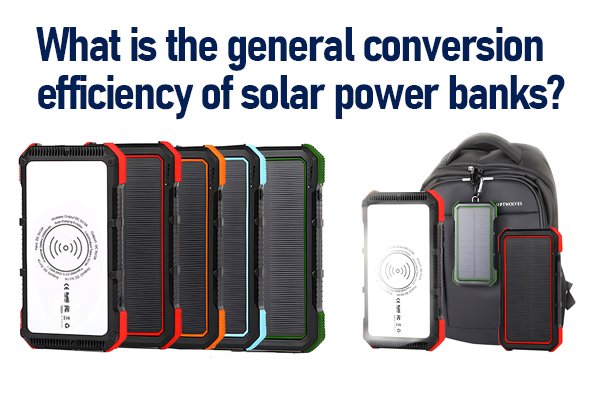
The conversion efficiency of solar power banks varies depending on factors such as the materials,technologies,and light conditions of the solar panels.The general situations are as follows:
Polycrystalline silicon solar panels:Their conversion efficiency is usually around 8%-12%.For example,for some ordinary polycrystalline silicon solar power banks,the efficiency of converting solar energy into electrical energy and storing it is approximately within this range under sufficient sunlight conditions.
Monocrystalline silicon solar panels:The conversion efficiency of monocrystalline silicon is relatively high,generally between 12%and 16%.Solar power banks using monocrystalline silicon solar panels can generate more electrical energy than those using polycrystalline silicon solar panels under the same light conditions,and the charging speed is also relatively faster.
Thin-film solar panels:The conversion efficiency of this type of panel is similar to that of polycrystalline silicon,usually around 10%-15%.However,it has the advantage of good flexibility and can adapt to some irregular surfaces,but the overall conversion efficiency is not particularly high.
Sunpower solar panels:As a highly efficient solar panel,its conversion efficiency can be as high as 24.2%.However,it is generally imported and relatively expensive.
Other specially designed or high-end products:Some solar power banks adopt special designs or advanced technologies,and their conversion efficiencies will be higher than ordinary products.For example,the 13W and 40W solar chargers of Guorui Sunshine have theoretical and practical application conversion efficiencies that can reach 22%and 22.5%respectively.
How to determine whether the conversion efficiency of a solar power bank meets the standard?
Here are some methods to determine whether the conversion efficiency of a solar power bank meets the standard:
Check product parameters and certifications
Check the product manual:The product manual of a formal solar power bank will clearly mark the conversion efficiency of its solar panel.You can directly check whether this data is within a reasonable range.Generally,the conversion efficiency of polycrystalline silicon solar panels is between 8%and 12%,and that of monocrystalline silicon and thin-film solar panels is between 12%and 16%.
Refer to certification certificates:Solar power banks with relevant authoritative certifications have more guaranteed performance indicators such as conversion efficiency.For example,products that have passed certifications such as CE and FCC indicate that they meet internationally recognized standards and can reflect that their conversion efficiency meets the standard to a certain extent.
Observe the relevant characteristics of the solar panel
Size of the area:Under the same conversion efficiency,the larger the area of the solar panel,the more light it can receive,the more electrical energy it can generate,and the relatively faster the charging speed.Generally speaking,if the area of the solar panel is too small,such as having a power of only about 1-1.5 watts,its charging efficiency will be very low and it can only be used as an emergency option.
Material and craftsmanship:Different materials of solar panels have different conversion efficiencies.For example,the conversion efficiency of monocrystalline silicon solar panels is relatively high,while that of polycrystalline silicon solar panels is relatively low.In addition,high-quality solar panels have a more refined manufacturing process,with a smooth surface and no obvious flaws,and their conversion efficiencies are also more guaranteed.
Actual testing and comparison
Test under standard conditions:You can compare the time required to fully charge the solar power bank under sufficient and stable sunlight conditions with the theoretical charging time stated in the product manual.If the actual charging time is significantly longer than the theoretical time,it may indicate that its conversion efficiency does not meet the standard.However,it should be noted that the actual charging time will also be affected by other factors,such as the remaining power of the power bank,the number and power of connected devices,etc.
Compare the charging effects under different light intensities:Observe the changes in the charging speed and output current of the solar power bank under different light intensities,such as strong light and weak light.Products with high conversion efficiency have relatively stable output currents under different light conditions,and the changes in charging speed are relatively smooth;while products with low conversion efficiency will have a significant decrease in output current and a significant slowdown in charging speed when the light intensity decreases.
Compare with products of known efficiency:If possible,you can conduct a comparative charging test on the solar power bank to be tested and a similar product with a known high conversion efficiency and stable performance under the same environment.If the charging speed of the product to be tested is significantly slower than that of the known high-efficiency product,it may indicate that its conversion efficiency does not meet the standard.
Detect the output current and voltage
Use professional instruments for detection:Use professional instruments such as multimeters to measure the output current and voltage of the solar power bank under sunlight irradiation.Then calculate the actual output power according to the formula”Power=Voltage×Current”,and then roughly estimate its conversion efficiency by combining factors such as the area of the solar panel and the light intensity.Generally speaking,under standard light intensity,the closer the output current and voltage are to the rated values of the product,the higher the conversion efficiency.
Observe the charging status of the charging device:When charging an electronic device,observe the charging speed and charging status of the device.If the device charges slowly and cannot be fully charged for a long time,it may be that the output current of the solar power bank is small and the conversion efficiency is low;on the contrary,if the device can be charged relatively quickly and the current is stable during the charging process,it indicates that the conversion efficiency of the solar power bank is relatively high.